
The Quiet Transformation of Mammoth Lakes:
Inside the North Village Development Boom
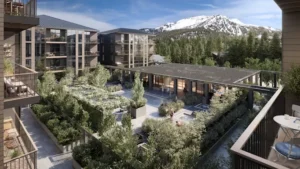
While the residential real estate market in Mammoth Lakes has dominated conversations in 2025, with all the talk of fluctuating prices, sales trends, and housing supply, the commercial and development sectors have received far less attention. And honestly, that’s where some of the most important changes are happening: the quiet but powerful transformations that could define the town’s next chapter.
I recently had the chance to sit in the new Limelight Hotel’s beautiful lounge during its opening week, sipping a drink and chatting with out-of-town visitors. The conversation started with the usual questions about condos and homes but soon shifted to the North Village area and the wave of development underway. They were genuinely surprised by the recent land sales and the scale of what’s coming. Their curiosity reminded me how little most people, visitors and locals alike, know about the commercial real estate story unfolding right in the heart of town.
What Is the North Village, really?
The North Village isn’t just a catchy name for the area around the Village Gondola. It’s a carefully planned 64-acre Specific Plan zone, encompassing 72 parcels and divided into six distinct land-use districts.
Adopted by the Town of Mammoth Lakes in 2000 and amended several times since, the plan creates a deliberate density gradient: the highest density near the Village core (closest to the gondola), gradually stepping down as you move outward.
Think of it like a wedding cake: the densest, tallest buildings rise in the center, while lower intensity uses spread toward the edges. This structure allows the Town to balance tourism-driven growth with the character and scale of surrounding neighborhoods.
North Village Specific Plan & Guidelines | Mammoth Lakes, CA – Official Website
The Scale of Development: The Numbers Tell the Story
Over the past 18 months, roughly 11.5 acres of land have seen new construction completed or actively underway, delivering or promising more than 480 hotel or condo rooms. That’s a significant increase in capacity in a town where year-round visitor demand continues to grow.
Even more telling is the amount of land that has changed hands:
-
More than 23.5 acres of development parcels have been sold or transferred
-
With density allowances supporting 48 to 80 rooms per acre (depending on zoning and entitlements)
-
This translates to a rough potential of around 1,400 rooms, not including commercial or mixed-use components
Some of these projects may include residential units rather than purely hospitality-focused developments, adding even more complexity and impact to the area.
Large-Scale Development Opportunities in Mammoth Lakes | Mammoth Lakes Real Estate
The Two Big Challenges: Housing and Parking
No major development wave comes without growing pains, and the North Village is no exception. Two challenges stand out: workforce housing and parking.
Workforce Housing: Progress, But More Is Needed
Housing has long been one of Mammoth Lakes’ biggest challenges, where tourism-driven demand often outpaces supply for year-round residents.
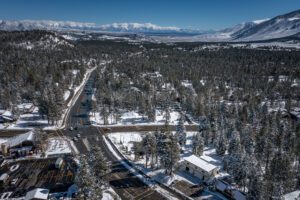
The good news is that the Town’s ambitious Parcel Project, a 25-acre centrally located site acquired in 2018, is making real progress. This multi-phase initiative aims to deliver up to approximately 450 affordable units, primarily rentals for low- and moderate-income households:
-
Phase 1 (“The Sawyer”) is complete and occupied
-
Phase 2 (“The Kingfisher”) is currently under construction
-
Additional phases are planned
Several new North Village developments are also incorporating on-site workforce housing units, along with in-lieu fees to support broader affordability efforts.
That said, I’ve long argued for redirecting a portion of the funding currently going to Mammoth Lakes Tourism toward helping developers create non-grant-dependent housing products tailored to locals. In my view, grant funding is often weighed down by government red tape and restrictions that make projects less affordable for both builders and residents. With strong demand on both the tourism and local-resident sides, more creative and flexible financing solutions could bridge the gap more sustainably and efficiently.
Parking: A Problem Rooted in the Original Plan
Parking remains another long-standing challenge tied to the original North Village design. The commercial core was initially planned with no parking, relying instead on transit, pedestrian access, shared parking concepts, and lower parking ratios typical of resort villages.
While developer fees were collected to fund more robust parking solutions (including a potential structure), those resources were not fully directed toward that purpose. The result is an undersized surface lot near the Westin, built only after persistent advocacy by a few council members.
As development accelerates, the Town should seriously reconsider the 4.06-acre Community Center site as a potential location for:
-
A multi-level parking structure
-
A transit hub
-
Improved mobility infrastructure
Relocating the existing community facilities and tennis courts to a better-suited site with upgraded amenities could unlock this central location for parking and transit—benefiting both visitors and locals without sacrificing the village’s walkable, resort-oriented feel.
A Fundamental Shift in Mammoth’s Future
All of these numbers and changes point to a fundamental shift. The North Village is no longer just the “gondola plaza.” It’s becoming the true mixed-use village core—with hotels, restaurants, retail, and public spaces designed to attract both visitors and locals.
The recent sales and construction activity signal strong investor confidence in Mammoth’s long-term potential.
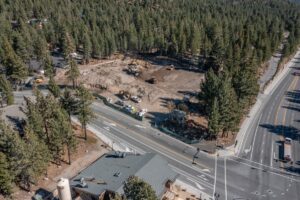
Opposition to these projects is understandable. But it’s important to remember that the framework guiding this growth comes directly from decisions the community supported when the North Village Specific Plan was adopted in 2000. That plan was created to concentrate growth intelligently, limit sprawl, and ensure Mammoth develops according to a deliberate vision rather than piecemeal expansion.
What This Means for Locals, Visitors, and the Town
-
For locals: More year-round economic vitality, better dining and entertainment, and real progress on housing and parking (if handled thoughtfully).
-
For visitors: A more complete, walkable, and dynamic resort experience.
-
For the Town: A chance to capture more economic benefit that has historically flowed to competing resort destinations.
Final Thoughts
The residential market will always grab the headlines. But the commercial and development story in Mammoth Lakes is the one that may shape the town’s future the most.
The North Village is quietly transforming, and it’s happening faster than most people realize.